Enclave: East Mostar
Wade Goddard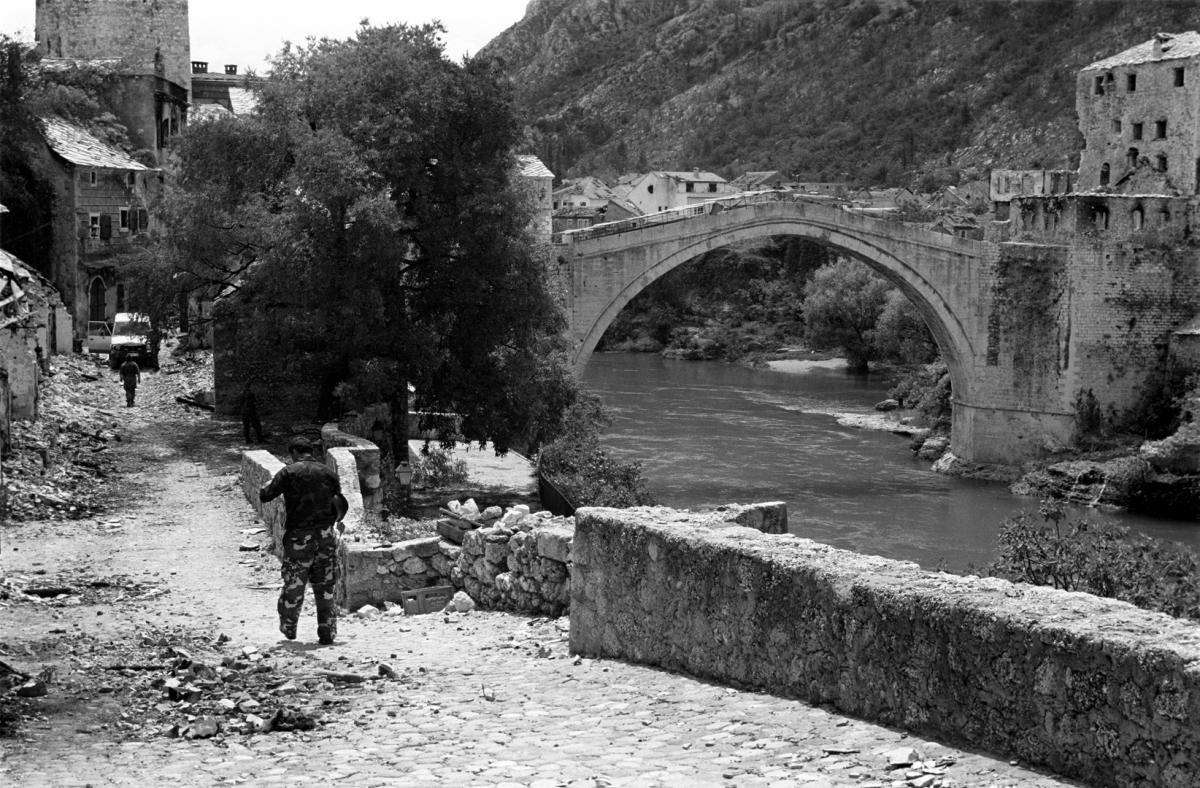
I first visited Mostar in late April 1992; the Bosnian War had begun a couple of weeks earlier. The Yugoslav Army (JNA) had Mostar surrounded and was shelling the town from the hills above. Together with three other photographers, I managed to sneak into Mostar with a small group of Croatian Defense Council (HVO) soldiers using the darkness as cover. The JNA controlled the east bank of the Neretva, putting the Old Bridge on the frontline. My colleagues and I managed to get within ten meters of the bridge, but the small arms fire was too heavy to spend too much time there. That was not only my first sight of Stari Most, but it was also my first taste of war. I was 22 years old, with no journalism experience and no idea what I was doing. I later returned to Mostar with a Croatian photographer, in mid June just after the HVO and the Territorial Defense, which later became the 4th Corps of the Bosnian Army (ARBiH), in a joint action amassed enough strength to force the JNA out of Mostar. It was during this visit that I first crossed the historic bridge. Shell fragments and fire from heavy machineguns and small arms had damaged many of the surrounding facades, and a few buildings had been burnt out. There were soldiers in the streets returning from patrols. We found a dead body stuffed into a street sewer. Some of the residents were just beginning to return to their homes.
Over the following months I passed through Mostar many times on my way into central Bosnia. Life in the city had become more normal. With the Yugoslav Army pushed back, Mostar was open to Croatia in the south and became the only open route into central Bosnia for non-Serb forces and civilians. Mostar’s population of Bosnian Muslims (Bosniaks) and Bosnian Croats was also represented by its two armed forces, the 4th Corps of the Army of the Republic of Bosnia and Herzegovina and the Croatian Defense Council, which was supported by Croatia. The two armies fought together against the Bosnian Serbs, and the two populations lived together quite harmoniously. It was during this period that I learnt about the Croatian Community of Herceg-Bosna, which had been founded in late 1991. Its intention was to create a purely Croatian entity in the Herzegovina, declare independencewith Mostar as the capital and unite with Croatia. In order to realise this dream of a greater Croatia, the Bosnian Croats had to expel the Bosniak population and other non-Croats, who would never agree to this.
Tensions between to two sides were rising gradually. In Mostar they broke into the open in May 1993. In the early hours of May 9, the HVO attacked Mostar using artillery, mortars, heavy weapons and small arms. The HVO took control of all roads leading into Mostar, and international organisations were denied access. I managed to get through a series of checkpoints with a Croatian friend who did all the talking. The soldiers at the checkpoints never knew I was a foreigner. Once in the city, we linked up with a militia for hire fighting for the HVO. In the four hours or so that we spent with them, they managed to cross only one street The fighting was intense, I had never experienced anything like it before or since. Croat forces took full control of the west side of the city up to the “boulevard”, the main street that runs parallel with the Neretva, arresting Bosniak men of fighting age and expelling their families to the east side of the city.
It wasn’t until September 1993 that I was able to get over to the east side of Mostar, the enclave wedged between the Croats in the west and the Serb-occupied mountains in the east; the roads north and south out of the enclave were also cut off by Bosnian Croat forces. The only way into the enclave was with UN aid convoys, which had been severely restricted in their movements during the summer months. One UN Aid convoy had made it into the enclave in mid-June. The second got through at the end of August. After delivering aid and attempting to leave the eastern half of Mostar, the Spanish-led convoy found its way barricaded by Bosniak demonstrators, who demanded permanent U.N. protection from the shelling by Bosnian Croats. This led to a deployment of Spanish UN troops on the east side, which was relieved every 24 hours. This was how journalists were able to get into and out of Mostar from September 1993 onward.
The encirclement and bombardment of east Mostar was well into its fourth month, when I climbed out of the back of a Spanish armoured transporter in the centre of the enclave. East Mostar was what I imagined the Warsaw Ghetto might have been like; the destruction, hunger, misery and squalor were my first observations. After spending more time there, I came to realise the resilience, determination and pride of the population.
Estimates varied on the size of the population of the enclave from 40,000 to 55,000. Bosnian Muslims were constantly being forced out of their homes on the west bank and pushed across the lines.
A Bosniak man working for the local radio station “Anel Zvonić” invited me to stay with him, his mother and his uncle. Their generous hospitality allowed me to spend week after week living in east Mostar. During the days I walked the streets of the enclave photographing the residents collecting water and firewood, sheltering in basements, going about their daily chores in a city that was killing them. In the evenings I spent time with friends that I had made, talking, smoking, listening to music if we had electricity, maybe drinking some spirits if we had any.
Snipers were a major problem, second after the shelling. As the enclave was so narrow and ran parallel with the frontline, much of the east side was in sniper range. Many of the regularly targeted spots were sign-posted, but the basic rule was that if you could see buildings on the west side, then a sniper could see you. In early November 1993, I photographed the Spanish UN rescuing two sniper victims, one of whom died of her wounds the other miraculously escaped unharmed, as the bullet lodged into the back of her bullet-proof vest. I left the enclave shortly after. Four days later I heard on the news that the Old Bridge had been destroyed. I knew what this would mean to the people of Mostar. It would be like losing a loved one; the bridge was something special to everyone from Mostar. I was sorry that I wasn’t there.
I kept returning to Mostar. A ceasefire was signed on the 23rdof February1994, ending nine months of bitter fighting. Prisoners of war from both sides began being released from May 20thonward. By the summer of 1994 things had started to improve. The utilities were slowly being restored, food was getting into the enclave.
Though the fighting has stopped, the scars of war, both physically and emotionally remain. Mostar is still a multi-ethnic city, though a divided one; and it will take several generations for this to change.